


Business Class Flights to China
From
$3,025*
Round trip from New York (JFK)
Enter your travel details now and get a customized quote from a dedicated travel expert







Flying business class to China
China is the thinnest major market we cover relative to its size, and that scarcity is the whole story. Three airlines fly nonstop from the United States to Beijing: Air China with around thirteen flights a week, United with ten, and Hainan Airlines on a single route into Seattle. For two of the largest economies in the world that is a remarkably small number of aircraft, and it explains why business class into China sits above almost every other Asian market we quote.
The nonstop map is short enough to memorise. Air China connects New York, Los Angeles, San Francisco and Washington. United flies San Francisco and Los Angeles. Hainan holds Seattle. Anyone whose home airport is not on that list is either taking a domestic positioning flight or connecting through Asia, and on this route the connection genuinely deserves consideration rather than being treated as the fallback.
- From $3,025* round trip
- 2 destinations covered
- All major airlines
- Personal quote in about an hour
China
How much do business class flights to China cost?
Recent business class fares to China started around $3,025 round trip on the lowest of the 2 routes we cover, and around $4,229 on the highest. What you pay depends far more on season and how far ahead you book than on which airline you fly.
Destinations in China

*Prices based on recent bookings, subject to availability and seasonality.
China business class FAQs
Air China with around thirteen weekly flights from New York, Los Angeles, San Francisco and Washington, United with ten from San Francisco and Los Angeles, and Hainan Airlines from Seattle into Beijing.
Because the route is thinly served. Three airlines and roughly two dozen weekly flights connect two of the largest economies in the world, and that little capacity leaves almost nothing pushing the published fare down.
The summer humidity and the winter cold both carry lower fares. The comfortable windows, April into early June and September into early November, are also the peaks. Avoid Chinese New Year entirely.
Frequently. Cathay Pacific, Korean Air and the Japanese carriers all fly a stronger business class than anything on the direct routing, and on a sixteen hour journey the extra connection is a small trade for a materially better seat.
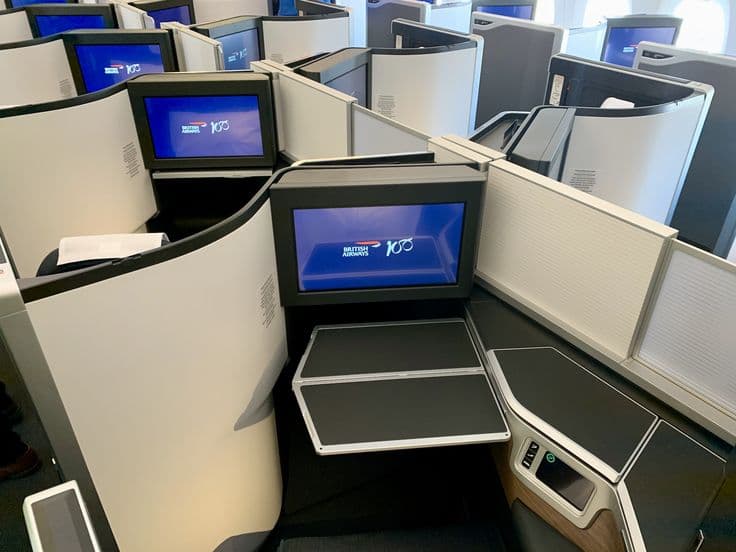
A suite with a closing door
What a business class ticket includes
From the moment you reach the airport to touchdown, every part of the journey is built to land you rested.
Priority check in
Fast track security and dedicated counters.
Premium lounges
Food, drinks and showers before you board.
Lie flat beds
Direct aisle access on long haul aircraft.
Fine dining
Multi course menus paired by sommeliers.
Amenity kits
Noise cancelling headphones, pyjamas, luxury kits.
Priority boarding
First on, first off, and extra baggage allowance.
Business Class Flights to China: The Full Picture
The nonstop map is short enough to memorise. Air China connects New York, Los Angeles, San Francisco and Washington. United flies San Francisco and Los Angeles. Hainan holds Seattle. Anyone whose home airport is not on that list is either taking a domestic positioning flight or connecting through Asia, and on this route the connection genuinely deserves consideration rather than being treated as the fallback.
Read moreShow less
That is because the one stop options are unusually strong. Cathay Pacific over Hong Kong, Korean Air over Seoul, Japan Airlines and ANA over Tokyo, and the Gulf carriers over Doha and Dubai all reach the Chinese mainland with a short second leg, and several fly a materially better business class than anything on the direct routing. On a sector that can run sixteen and a half hours from New York, a better seat plus a connection frequently beats an average seat flown straight through.
Distance is the other constant. Los Angeles to Beijing runs a little over thirteen hours, San Francisco around thirteen and three quarters, Boston sixteen and New York sixteen and a half. At those lengths the cabin stops being about comfort and starts determining whether the first day on the ground is usable. It is the clearest case for a flat bed anywhere in our network apart from South Africa.
The weather is extreme at both ends and the comfortable windows are narrow: April into early June, and September into early November. Unusually, those windows are also the peaks. Most destinations reward travelling in the shoulder season; here the shoulder is the good weather and it is priced accordingly, so the saving comes from accepting either the summer humidity or the winter cold.
Chinese New Year overrides every other consideration. It moves between late January and late February and triggers the largest annual human migration on earth. Domestic and regional flights sell out completely, fares climb steeply and much of the country closes for business. Check the date before fixing anything else about the trip.